

- Home
- News & Updates
- Latest Release of Illumina Connected Multiomics Expands Multiomic Discovery and Research Evidence Exploration
-
Illumina Connected Multiomics
-
News
- 09/24/2026
Latest Release of Illumina Connected Multiomics Expands Multiomic Discovery and Research Evidence Exploration
New capabilities in Illumina Connected Multiomics v1.3 help research teams connect matched multiomic analysis, Correlation Engine evidence exploration, private molecular signatures, and governed study access in a more integrated discovery workflow.
Multiomic studies can reveal patterns that are difficult to detect from a single data type alone. But as researchers bring transcriptomic, proteomic, methylation, and other molecular layers together, interpretation can become fragmented across separate analysis tools, evidence sources, and study records.
Illumina Connected Multiomics v1.3 helps address that fragmentation by bringing more of the research workflow into a single environment. Researchers can explore integrated molecular patterns, compare signatures with curated Correlation Engine evidence, preserve private findings for reuse, and manage study access across shared teams without treating each activity as a separate step.
Discover biological patterns across multiple omic layers
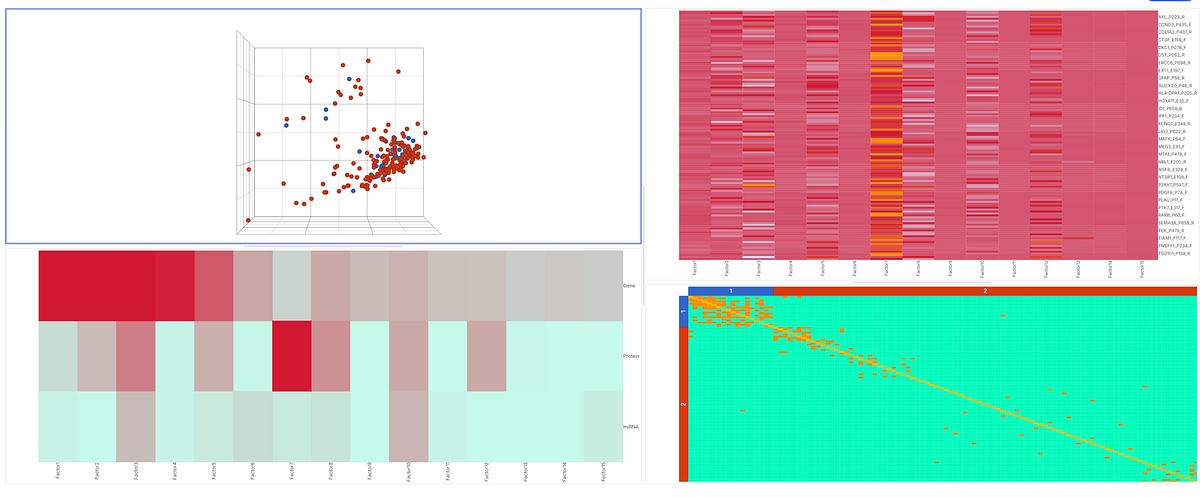
Integrated subtype discovery is most useful when molecular differences are distributed across layers rather than concentrated in a single assay. A subtype that is weakly separated in RNA data alone may become more apparent when genomic, transcriptomic, proteomic, and methylation patterns are analyzed together.
Illumina Connected Multiomics now supports integrated subtype discovery through Multi-Omics Factor Analysis (MOFA) and Similarity Network Fusion (SNF), enabling researchers to jointly analyze matched omic layers within a single study. When genomic, transcriptomic, proteomic, and methylation data are viewed together, teams can explore whether patterns that appear modest in one layer become more informative across a matched multiomic profile, such as whether proteomic patterns refine methylation-based sample groupings or reveal potential relationships spanning multiple molecular layers.
Compare molecular signatures with Correlation Engine evidence in natural language
Finding a molecular signature is only the beginning. Researchers often need to ask whether similar patterns have appeared in other studies, biological contexts, perturbations, or disease models before deciding which findings to investigate further.
With expanded Correlation Engine integration, researchers have two complementary ways to explore external evidence. Building on the atlases task introduced in v1.2, v1.3 adds natural language query, meta-analysis, and bioset-bioset correlation tasks to expand how researchers explore related biological contexts, datasets, signatures, and curated Correlation Engine evidence. This enables researchers to compare their molecular signatures with curated Correlation Engine evidence and use those results to guide interpretation or follow-up analysis.
Support governed collaboration for core labs, CROs, and shared research teams
Modern multiomics programs frequently involve multiple researchers, teams, and service organizations working together on related studies. But broad workgroup access or duplicated study copies can make it harder to manage participation, oversight, and continuity across research programs.
This release extends collaboration support with governed, study-level access control. Large core labs, CROs, and shared research teams can operate within a single workgroup while using study-level isolation to manage who participates in specific studies. A service lab supporting multiple research projects can work from one operational environment while maintaining clearer boundaries around study participation and access.
What this release enables
For research teams building larger multiomic programs, the value of v1.3 is not limited to any single analysis step. The release helps connect subtype discovery, evidence exploration, institutional knowledge reuse, and governed collaboration so findings can move more easily from initial analysis to broader research interpretation.
Instead of treating signatures, evidence searches, study access, and prior findings as separate activities, teams can work across them in a shared environment designed to make multiomic research more connected, reusable, and collaborative.
Explore Illumina Connected Multiomics
Start an instant free trial today to see how Illumina Connected Multiomics can support integrated multiomic analysis, research evidence exploration, and governed study workflows.
For Research Use Only. Not for use in diagnostic procedures.
M-GL-04761