

- Home
- News & Updates
- DRAGEN v4.6 scRNA with STAR: simpler setup and results closer to native DRAGEN
-
DRAGEN
-
Product updates
- 11/16/2026
DRAGEN v4.6 scRNA with STAR: simpler setup and results closer to native DRAGEN
DRAGEN-native trimming now added
In our earlier post, Your PIPseq workflow is consolidating into DRAGEN, we introduced DRAGEN scRNA with STAR in DRAGEN v4.5. For PIPseq data we recommended three STAR settings: alignIntronMax 25000, clip5pNbases 1, and clip3pAdapterSeq polyA. Two of these settings trimmed reads because DRAGEN could not do so in software mode. However, STAR could not effectively remove the TSO, polyA, and polyG sequences that native DRAGEN trims. As a result, STAR received many more untrimmed or partially trimmed reads.
DRAGEN™ v4.6 addresses this trimming issue by running the DRAGEN read trimmer before STAR, so both aligners start with the same trimmed reads. The additional trimming options should no longer be used; only the STAR alignment settings remain. We also tested a new set of STAR parameters on two ISCP libraries with very different read lengths and found that they bring STAR alignments in line with native DRAGEN.
Can we rename this to something like "Added DRAGEN-native trimming to STAR workflow"?
Updating to DRAGEN v4.6
- Drop the trimming options. Remove clip5pNbases 1 and clip3pAdapterSeq polyA. DRAGEN trims the reads before STAR sees them.
- Replace alignIntronMax 25000 with the new STAR parameters (Table 1). Set --scrna-min-mapq 4 and point DRAGEN at a STAR index built from the masked genome.
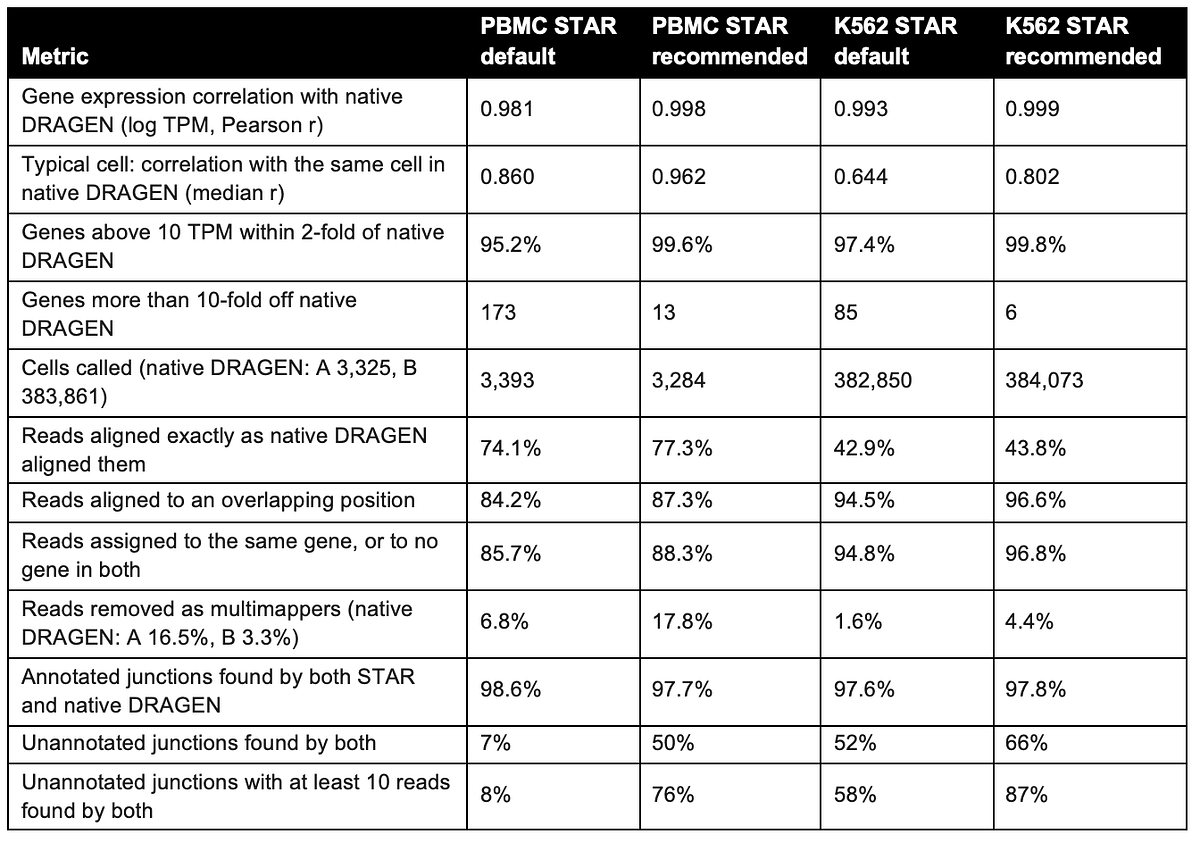
- In the two libraries tested, gene expression values showed closer alignment. With the new settings, gene expression correlates with native DRAGEN at r = 0.998 and 0.999. STAR also calls splice junctions more stringently, more closely resembling DRAGEN map-align defaults. STAR's default settings are more permissive than DRAGEN and include more multimapped alignments and novel splice junctions.
Recommended settings to more closely align STAR results with DRAGEN
Add the following settings to your software-mode command to make STAR alignment scoring more closely match DRAGEN map-align.
Table 1. Recommended settings for DRAGEN scRNA with STAR in v4.6
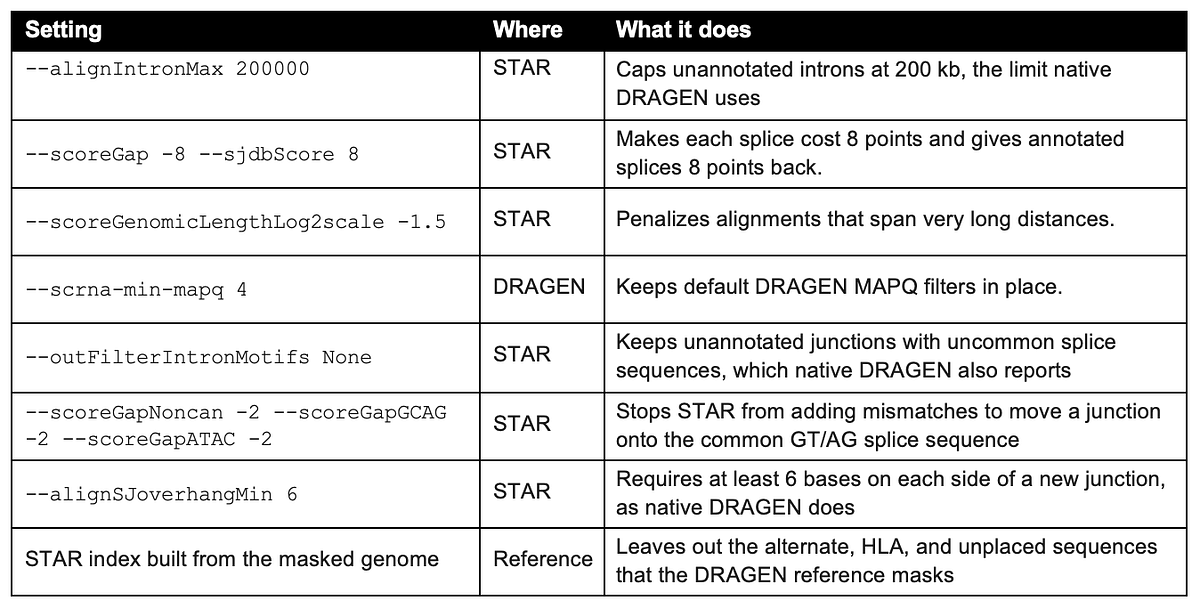
Pass the STAR parameters as one string with --single-cell-star-mapper-options:
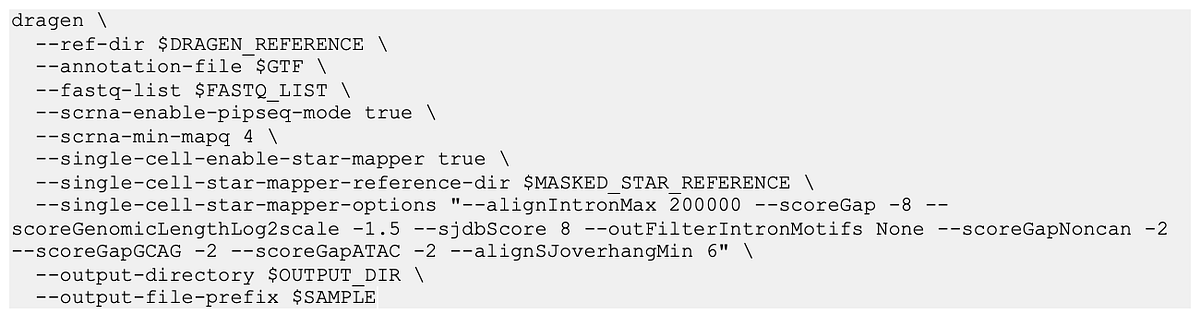
To build the masked STAR index, replace the regions in the DRAGEN reference's mask BED file with N in the genome FASTA, keeping every contig at its full length, and build the index from that FASTA and your GTF (for example, STAR --runMode genomeGenerate --genomeSAsparseD 3 --sjdbOverhang 69).
How we tested
We ran each library three ways with DRAGEN v4.6.2 on hg38 with GENCODE v44: native DRAGEN, DRAGEN scRNA with STAR using default settings, and DRAGEN scRNA with STAR using the recommended settings. Every run of a library used exactly the same reads.
Table 2. The two ISCP libraries

Table 3. DRAGEN scRNA with STAR compared with native DRAGEN, default and recommended settingsGene expression results show high correlation
Gene expression results show high correlation
STAR's default settings already give gene expression close to native DRAGEN, and the recommended settings close most of the remaining gap (Figure 1).
- Correlation with native DRAGEN rises to 0.998 (sample A) and 0.999 (sample B), from 0.981 and 0.993 with default settings. The genes that differ more than 10-fold drop from 173 to 13 on sample A and from 85 to 6 on sample B.
- Individual cells agree too. For the typical cell, the correlation with the same cell in native DRAGEN rises from 0.860 to 0.962 on sample A and from 0.644 to 0.802 on sample B. Sample B's cells are small, with a median of 216 transcripts each in native DRAGEN, so a handful of reads moves a cell's correlation.
- HLA genes are recovered. With default settings STAR assigns 32,895 transcripts to HLA genes on sample A, a fraction of native DRAGEN's 212,481, because it aligns many HLA reads to the extra HLA allele sequences in the reference, which carry no gene annotation. With the masked index, 212,857 HLA transcripts are recovered. Sample B: 83,103 and 499,932, against 508,195, respectively.
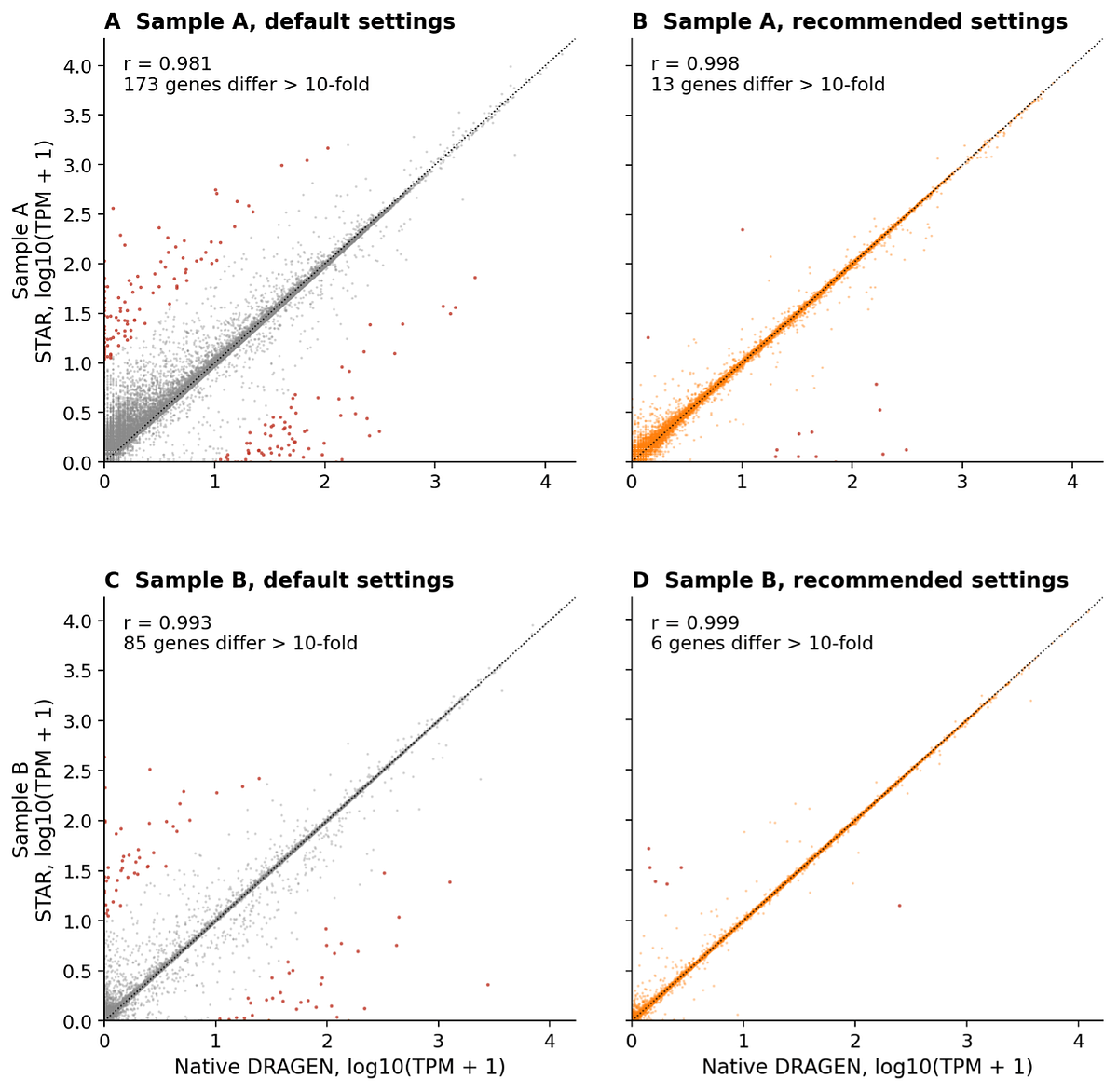
Figure 1. With the recommended settings, gene expression from STAR matches native DRAGEN in both libraries
Pseudo-bulk expression of each gene, native DRAGEN (x-axis) against DRAGEN scRNA with STAR (y-axis), with default settings (A, C) and the recommended settings (B, D), for sample A (top) and sample B (bottom). Red points are genes that differ more than 10-fold. r is the Pearson correlation of log TPM.
Alignment: the same reads in the same places
Comparing the two BAM files read by read shows how closely STAR now follows native DRAGEN (Table 3).
- Most reads align to overlapping positions. With the recommended settings, 87% (sample A) and 97% (sample B) of reads align to a position overlapping native DRAGEN's, and 88% and 97% go to the same gene.
- Base-for-base matches depend on read length. 77% of sample A's 72 bp reads have exactly the same alignment in both workflows, against 44% of sample B's 250 bp reads. A longer read gives the two aligners more room to differ by a base or two at its ends or around a splice: 74% of sample B's reads still start at the same base.
- Multimapping reads are handled the native DRAGEN way. Native DRAGEN does not count a read that fits two or more places equally well. STAR with default settings counts many of them; with the recommended settings, STAR removes about as many reads as native DRAGEN (17.8% against 16.5% on sample A, 4.4% against 3.3% on sample B).
Splice junctions: very similar to native DRAGEN
Splice junctions are where default STAR and native DRAGEN differ most (Figure 2). Both find nearly all the same annotated junctions under any setting. The difference is in unannotated junctions, the ones not in the GENCODE annotation.
- Default STAR reports far more unannotated junctions. 149,373 on sample A against native DRAGEN's 15,555, and 189,292 on sample B against 147,653. With default settings a splice costs STAR nothing, and introns can run to hundreds of kilobases, so STAR splices a read whenever it extends the read. Its unannotated introns have a median length of 14,187 bp on sample A, against 1,435 bp for native DRAGEN.
- With the recommended settings the counts come back in line: 15,995 on sample A and 120,009 on sample B. For sample B, that is fewer than native DRAGEN, and 85% of the gap is junctions seen in a single read. Among junctions with at least 10 reads, the counts are close for both samples: 627 against 547 (A) and 7,560 against 7,728 (B).
- They are mostly the same junctions. The share of unannotated junctions found by both STAR and native DRAGEN rises from 7% to 50% on sample A and from 52% to 66% on sample B. Among junctions with at least 10 supporting reads, the number of shared junctions jumped from 8% to 76% and from 58% to 87%.
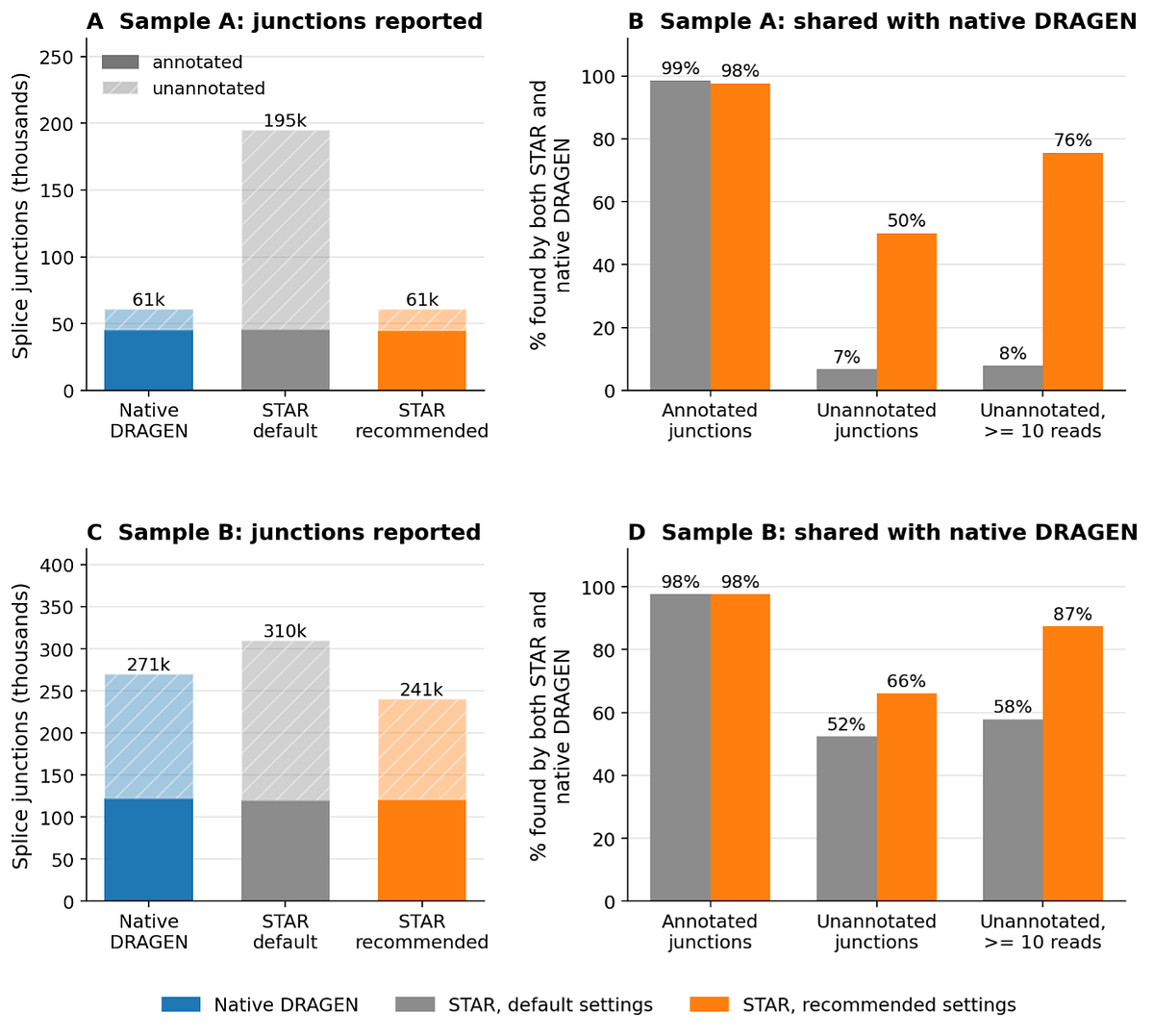
Figure 2. The recommended settings bring STAR's splice junctions in line with native DRAGEN
(A, C) Splice junctions reported by each workflow after the same junction filter, annotated in GENCODE v44 (solid) and unannotated (hatched). (B, D) Percentage of junctions found by both STAR and native DRAGEN: all annotated junctions, all unannotated junctions, and unannotated junctions with at least 10 reads in either workflow.
What still differs
The two aligners use different algorithms, so some differences remain. About 13% (sample A) and 3% (sample B) of reads align to a position that does not overlap native DRAGEN's alignment. Among unannotated junctions with at least 10 reads, 24% (A) and 13% (B) are still found by only one workflow. Most of these are the same intron placed a few bases apart, or with one splice site moved. Many of the others are native DRAGEN junctions with uncommon splice sequences, which STAR still scores below the common GT/AG sequence.
What you need to do
If you use DRAGEN scRNA with STAR with the v4.5 settings:
- Remove clip5pNbases 1, clip3pAdapterSeq polyA, and alignIntronMax 25000 from --single-cell-star-mapper-options.
- Add the STAR parameters in Table 1, set --scrna-min-mapq 4, and build a STAR index from the masked genome.
If you are new to DRAGEN scRNA with STAR:
- Start with the recommended settings. You do not need any trimming options in v4.6.
If you use native DRAGEN:
- Nothing changes. DRAGEN scRNA with STAR is an option for teams who need STAR alignments, and with these settings its results line up closely with yours.
Compatibility notes
- STAR runs inside the DRAGEN scRNA pipeline. Enable it with --single-cell-enable-star-mapper true together with --enable-single-cell-rna true or --scrna-enable-pipseq-mode true.
- STAR needs its own index, built from the same genome FASTA and GTF as the DRAGEN reference.
- DRAGEN v4.6 includes STAR 2.7.11b. To use another STAR build, set --single-cell-star-mapper-path.
- With STAR enabled, --down-sampler-normal-subsample is applied after STAR aligns all reads.
For full details, see the STAR Aligner section of the DRAGEN v4.6 single-cell RNA user guide and the STAR manual.
Key takeaway
In DRAGEN v4.6, trimming is handled automatically, so the STAR trimming options from v4.5 should not be used. Replace them with the recommended STAR parameters for DRAGEN v4.6, and DRAGEN scRNA with STAR gives, in this study, gene expression, read alignments, and splice junctions that closely match native DRAGEN on both short-read and 250 bp ISCP libraries.
---
For Research Use Only. Not for use in diagnostic procedures.
M-GL-05087